Sunday, March 25, 2012

ABU DHABI

In January, I returned from a week’s trip to Cuba and blogged about it – chiefly its architecture, which constituted a rich and detailed record of the island’s history over the past hundred years. The opulent, Europeanized villas; the splended Catholic churches; the public squares; the narrow warren of alleyways of Old Havana all gave way, starting in 1959, under the avalanche of Communism. The villas were given to the People, who couldn’t take care of them, and most of them crumbled into splendid, decaying old piles. The churches have slowly been colonized by Senterria, the local form of Yoruba folk religion. The Castro regime built blocks of depressing Soviet-style flats and monumental, faceless public buildings. But Old Havana remains what it was, and forms the core of a lively, West-friendly fun-loving culture that refuses to die.

Two weeks ago, I got back from a visit to a country so different from Cuba as to represent its diametrical opposite: Abu Dhabi, the wealthiest of the United Arab Emirates. And again, architecture has a story to tell. Abu Dhabi, unlike Cuba, has virtually no history; fifty years ago it was desert. And the indigenous culture, if it can be called that, is Bedouin, and therefore, by definition, fleeting and insubstantial, for the Bedouins were rootless wanderers.

Where Cuba is a very poor country, Abu Dhabi, which owes its existence to its enormous oil reserves, is rolling in wealth. A (somewhat oversimplified) profile of an Emirati is someone who has little or no education (why bother, when there’s no vocational motive?), doesn’t work (ditto), is waited upon by servants who have immigrated from other countries (and who live outside the city in what are called – I kid you not – labor camps). The typical family car is a Porsche Cayenne.

And the architecture? Monumentality knows no bounds in Abu Dhabi (it’s even more striking in neighboring Dubai). Ego-driven oil-rich sheikhs have, with no master plan or guiding purpose, created a city of enormous glass towers – apartment buildings, office buildings, hotels – quite indifferent to the fact that their occupancy rate is ridiculously low. There is no dominant style, unless whimsical fancy may be said to be a governing esthetic. Consider, for example, the towers pictured below, which are fairly typical:


Bizarre? Tasteless? Look at the decor of the Grand Mosque. The exterior is impressive enough. . . .


But the interior is tacky; it looks as if it had been furnished by a a policeman's wife in Nassau County. Who came up with this chandelier?


Here's the opposite number of that chandelier in the extraordinarily beautiful Hassan II Mosque in Casablanca:


The physical setting of Abu Dhabi -- on the Gulf of Arabia, facing west toward Iran -- is stunning. But the Emiratis don't mix with tourists or expats; theirs is a closed community, but an untethered one: not truly Arab but not Western either. They've taken the worst of our culture, its obsession with material goods, and broken away from the best of Arab culture, its subtlety, intellectual accomplishments, and style. As of now, there's no "there" there.

Saturday, January 7, 2012

CUBA!

I wanted to go to Cuba for the same reason that many Americans go there: we all heard/saw Buena Vista Social Club and were blown away by the music. But when we got there, during the last week of December, though there was music aplenty (some wonderful, most OK), the way that Havana imposed its presence on us was through its architecture.

I'm not qualified to write about recent Cuban political history -- or architecture, for that matter. But the enormous variety of styles, and the variation in the condition of the diverse buildings and neighborhoods, was so clearly evident that I can't resist.

Old-style buildings in Havana and its environs date back to the days when it was a Spanish colony, and even after it became an independent republic in the 19th century, Cubans continued to build in the Spanish mode, which is exemplified by the opulence and elegance of those few structures that have been restored and/or preserved, like the Hotel Sevilla --


-- and this monumental government edifice --


But most of Havana's streets -- particularly in Old Havana, the "autentico" neighborhood that draws tourists -- looks like this


Though some look like this:


It's clear from your first stroll that while most citizens are fighting the good fight against erosion and decay, it's not always winnable. In another half-century, if the regime doesn't change, and the island stays closed to U.S. trade and tourism, might not the whole city look like this?


What happened was that after the upper class left in a hurry in 1959, with only those assets they could carry, Castro gave their houses to the people -- who couldn't afford to keep them up. What the New Regime itself built has an inevitable Russian tinge to it: monumentally dull and highly politicized buildings:


So, in a way, Havana's architecture resembles its cars: there are stunning blasts from the past (the favorites seem to be Chevy Bel-Airs from 1955 to 57, like this one, which would cost about $70,000)


with a few brand-new Audis and Beamers mixed into a general population of clapped-out Ladas (the Soviet people's car, with none of the charm or engineering of the VW Beetle).

So: here is a city of two million people, part of it looking like Dresden after the fire-bombing, part of it a nondescript commercial and government metropolis, and part of it heartbreakingly beautiful. I leave you with an image of how some Cubans lived before Fidel & Co. --


and a more accurate picture of a city that's in which even the most modest attempts at beautification have to be seen through chain-link fences:

Thursday, October 27, 2011

A 2031 LOVE STORY

Back in the year 2011, twenty years ago, four children lived on a magical island called Utila, which looked like a whale swimming in a blue-green sea.

Maxim, who was four,


and Pai, who was eight months old,


were brother and sister.

Bine, who was four years old,


and Angus, who was two,


were also brother and sister.

All four of these children were friends and played together all the time, except that Pai, being so young, couldn’t talk to her friends, because she couldn’t talk at all. Still, she was part of the charmed circle, or rather rectangle, that these children formed. One thing they had in common was that each of them possessed stunning beauty, as you see. They were also very smart and very nice, which some people think is even more important than being beautiful.

Maxim and Bine, who were the same age, had been friends their whole life. In fact, they loved each other, and it seemed natural to them that when they grew up, they would get married and have smart, nice, beautiful children of their own, although they didn’t yet know how to have children.

But when they started going to school, another girl fell in love with Maxim.


and that made Bine worried and sad. She worried that Maxim would fall out of love with her and in love with the other girl, and that they wouldn’t be able to get married after all.


Maxim didn’t worry about things like that because he knew that he was a prince and Bine was a princess, and that someday he would build a house for her. Besides, he was a boy, and boys don’t worry about things; they just want to get through the day.

But Bine need not have worried. Even though he and his parents and his sister moved away from the magical island to a country across the ocean, Maxim went on loving Bine. Over the years, many other girls fell in love with him because he had the longest eyelashes of any boy they knew. And many other boys fell in love with Bine’s blond hair and brown eyes. When other people fell in love with Maxim and Bine, they would sometimes forget each other for a little while, but then Bine would remember that it was Maxim she really loved, and Maxim would remember that it was Bine he really loved. And last year, in 2030, they got married on the beach of the magical island of Utila.

But what of Angus and Pai? Pai moved away from the island with her parents and Maxim before she and Angus could become close friends, and she only remembered him from pictures of him that her parents showed her. But he remembered her very well, because he had fallen in love with her way back when they were very little.


And when her whole family came back to the island for the wedding of Bine and Maxim, she looked at the handsome young man whom Angus had grown up to be, and fell in love with him. And Angus looked at the beautiful young woman whom Pai had grown up to be, and fell in love with her all over again. For the next year, even though Pai had gone back to America, where she was attending a school called the New York University, she and Angus texted and twittered and e-mailed and telepathed and mind-locked every day, so it was almost as if they were together, except that they couldn’t touch, or go swimming, or eat lunch with each other. But they knew each other so well that they wanted to spend their whole lives together, and one year to the day after Bine and Maxim had gotten married on the beach, Pai and Angus got married on the beach, at the same spot, near the house of Amanda and John, the mother and father of Bine and Angus.


And Danielle and Benoit, the parents of Maxim and Pai, came to both of these weddings.


and so did the old, doddering grandparents of the four now-grown-up children, and everybody ate gooey cake and drank bubbly champagne. And they all lived happily ever after.

Sunday, September 11, 2011

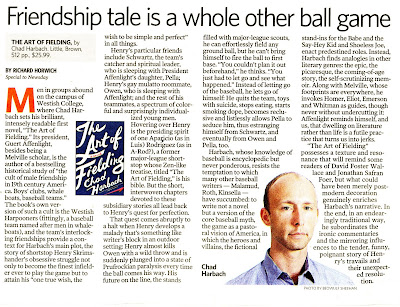
REVIEW OF "THE ART OF FIELDING," NEWSDAY, SEPT. 11, 2011


Men in groups abound on the campus of Westish College, where Chad Harbach sets his brilliant, intensely readable first novel, The Art of Fielding. Its president, Guert Afflenlight, besides being a Melville scholar, is the author of a best-selling historical study of what is described as “the cult of male friendship in nineteenth-century America . . . boys’ clubs, whale boats, baseball teams.” The book’s own version of such a cult is the Westish Harpooners (fittingly, a baseball team named after men in whale boats), and the team’s interlocking friendships provide a context for Harbach’s main plot, the story of shortstop Henry Skrimshander’s obsessive struggle not only to become the finest infielder ever to play the game but to attain his “one true wish, the wish to be simple and perfect” in all things.

Henry’s particular friends include Schwartz, the team’s catcher and spiritual leader, who is sleeping with President Affenlight’s daughter, Pella; Henry’s gay mulatto roommate Owen, who is sleeping with Affenlight himself; and the rest of his teammates, a spectrum of colorful and surprisingly individualized young men. Hovering over Henry is the presiding spirit of one Aparicio (as in Luis) Rodriguez (as in A-Rod?), a former major-league shortstop whose Zen-like treatise, meta-titled The Art of Fielding, is his bible, as Moby-Dick is Affenlight’s. But the short, interwoven chapters devoted to these subsidiary stories all lead back to Henry’s quest for perfection.

That quest comes abruptly to a halt when Henry (like several real-life ballplayers – Steve Blass, Steve Sax, Chuck Knoblauch) develops a malady that’s something like writer’s block in an outdoor setting: Henry almost kills Owen with a wild throw and is suddenly plunged into a state of Prufrockian paralysis every time the ball comes his way. His future on the line, the stands filled with major-league scouts, he can effortlessly field any ground ball but he can’t bring himself to fire the ball to the first base. “You couldn’t plan it out beforehand,” he thinks. “You just had to let it go and see what happened.” Instead of letting go of the baseball, he lets go of himself: he quits the team, toys with suicide, stops eating, starts smoking dope, becomes reclusive and listlessly allows Pella to seduce him, thus estranging himself from Schwartz, and eventually from Owen and Pella too.

Harbach, whose knowledge of baseball is encyclopedic but never ponderous, resists the temptation to which many other baseball writers – Malamud, Roth, Kinsella -- have sucumbed: to write not a novel but a version of the core baseball myth, the game as a pastoral vision of America, in which the heroes and villains, the fictional stand-ins for the Babe and the Say-Hey Kid and Shoeless Joe, enact predestined roles. Instead, Harbach finds analogies in other literary genres: the epic, the picaresque, the coming-of-age story, the self-scrutinizing memoir. Along with Melville, whose footprints are everywhere, he invokes Homer, Eliot, Emerson and Whitman as guides, though never without ironically undercutting this technique; Affenlight reminds himself, and us, that dwelling on literature rather than life is a futile practice that turns us into jerks.

The Art of Fielding posesses a texture and resonance that will remind some readers of David Foster Wallace and Jonathan Safran Foer, but what could have been merely post-modern decoration genuinely enriches Harbach’s narrative. In the end, in an endearingly traditonal way, he subordinates the ironic commentaries and the mirroring influences to the tender, funny, poignant story of Henry’s travails and their unexpected resolution.

Saturday, August 13, 2011

RULES OF THE ROAD


THE RIGHT (LEFT) SIDE


It makes me crazy, as I drive or bike around the East End, to see so many walkers, runners, strollers, moms/nannies pushing baby carriages, sometimes two or three abreast, on the right side of narrow shoulderless tree-lined and therefore shadowy roads – Stony Hill Road in East Hampton comes to mind -- which is the wrong side of the road for them. Their backs are to the traffic. Often they’re on their cells; if not, they’re listening to their iPods, as I bear down on them. Often it’s twilight. Often they’re wearing dark clothing. Come on, people! Don’t you want at least a fighting chance at surviving an encounter with a motorist who is blinded by the sun or the darkness or fiddling with his own phone or music player?

When I come up on a hapless pedestrian, though I know it stamps me instantly as a curmudgeon who is to be either ignored or given the finger, occasionally I can't resist the urge to slow down and try to reason with the 16-year-old girl or the portly middle-aged fellow inches from my right fender. “Safer to run facing traffic!” I’ll yell through my lowered passenger-side window. The other day when I did this, a woman pushing a stroller gave me a thoughtful look, said “Thanks,” and, I watched her cross to the left side in my rear-view mirror. I was so happy, I almost ran down a runner a hundred feet further on.


Tuesday, August 2, 2011

INEXORABILITY


What's on my mind today is Fate. To be specific, the fate of a single, nondescript brown moth that landed its bedraggled self on the steaming tennis court whose bench a friend and I were sitting on between games. No sooner had the moth touched down than, as if in some infernal Rube Goldberg device, a tennis ball detached itself from a lesson being given two courts away and trundled, slowly but very straight, toward us and the moth. And as its momentum expired, it homed in on the fragile creature and with on its final turn, like some fuzzy juggernaut, ran over it. It was sheer coincidence, of course, but the vector was so precise that it felt like something else. What would the last thought of the moth, had it been sentient, have been? Something like, "Of all the gin joints in all the wor--"

Monday, August 1, 2011

ROMEO AND JULIET IN AFGHANISTAN


The Times headline read “Afghans Rage at Young Lovers; A Father Says Kill Them Both.”

The bare facts are these: two teenagers “of different ethnicities” –- Rafi (pictured above in his prison cell) is Tajik, Halima is Hazara (guaranteeing that a marriage between them would not have been arranged by their parents) -- tired of meeting in secret, obtained a car and eloped, heading for a courthouse where they intended to marry. They had driven only thirty feet when a group of men stopped them, pulled them into the road, and interrogated them: what right had they to appear in public together? “An angry crowd of 300 surged around them, calling them adulterers and demanding that they be stoned to death or hanged.”

Police arrived, and a riot ensued, in which one man was killed. The kids were spirited off to jail (undoubtdly the safest place for them), where they languish at present, awaiting trial. There is no indication that they had engaged in, or were engaged in, any activity more culpable or subversive than sitting companionably together in an automobile.

“Why can we not marry each other, or love each other?” the 17-year-old Halima asks, from her prison cell.

If this sounds familiar, perhaps its because the narrative’s outlines conform so perfectly to those of Romeo and Juliet. That is, depending on how it ends, we might well have cause to describe this story as a tragedy. Except that, in Shakespeare’s play, only two characters display anything like the fanaticism that seems to characterize the Afghan social milieu -- Juliet’s hot-headed Tybalt (who indeed thinks Romeo should be put to death, by himself) and Juliet’s father, in a single scene in which he loses his temper volcanically. The deaths of the young protagonists come about because of a series of miscalculations and fatal coincidences: Romeo kills himself because he believes Juliet dead when she is in fact living, and Juliet kills herself when the Friar, who is by her side in the family mausoleum, is spooked and runs away. The parents, at the plays end, mourn their children and erect statues in memory of them.

But in the present case, the girl’s uncle visited her in prison to inform her that she had shamed the family, and that they would kill her once she was released. Her father stated, “What we would ask is that the government should kill both of them,”

What’s happening in Afghanistan seems to me less than tragic and worse than tragic. Tragedies are about heroic attempts to defeat overwhelming odds, in which the dignity and seriousness of the hero’s (or heroes’) downfall produces in us a complicated blend of admiration, sadness, and resignation. I don’t know about you, but all I can feel about this is rage and a sense that human culture and the bonds of family as we know them have somehow been suspended. There’s no dignity, no heroism, no sense of individual fate playing itself out. Two children are about to be crushed by an ideologically-driven machine, and there seems to be no way of stopping it. (Of course, the law is always a machine, blind and capable only of quantitative judgments; that’s why Cocteau titled is version of the Oedipus story La machine infernelle.) The genre that fits here is not tragedy but irony, whose point of view is such that it reduces human life to a meaningless shadow-play. Macbeth described human life as a tale told by an idiot, signifying nothing. The lives of Rafi and Halima, in their culture, apparently signify nothing. It’s not a tale told by an idiot; it’s a tale about idiots.